Unfortunately this page does not exist in the desired language.
STRzero
Climate strategy
The global community faces the enormous task of slowing down man-made global warming. To do this, it must become CO2-neutral. This means that emissions of climate-damaging gases must be massively reduced and CO2 must be removed from the atmosphere. If we fail to do so, we must expect serious and irreversible consequences for the entire planet.
Flughafen Stuttgart GmbH (FSG) intends to take decisive steps towards climate protection. We demonstrate a sense of responsibility in airport operations. Climate protection is a key area of action for fairport and is firmly established as a strategic corporate goal. By pursuing the STRzero climate strategy, we will achieve our ambitious goals.
We have set ourselves a binding and ambitious climate target: net greenhouse gas neutrality by 2040 in Scope 1 and 2. Our climate strategy STRzero will take us there.
Stuttgart Airport is taking decisive action to protect the climate. To protect our planet, we adhere to these six points:
We set ourselves binding climate targets.
We promote renewable energies.
We build sustainably.
Sustainable mobility drives us forward.
We help accelerate lower emission aviation technologies.
Together, we can achieve our climate goals.
CO2eq = CO2 equivalents
Base year 1990: 15.927 CO2eq; 2010: 35.484 CO2eq
We set ourselves binding climate targets.
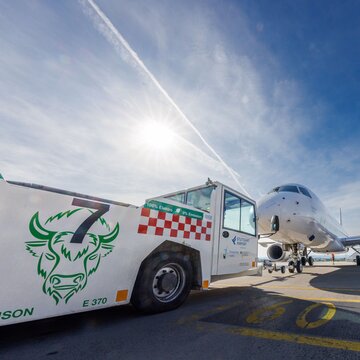
Destination STRzero: Stuttgart Airport will reduce its direct greenhouse gas emissions to net zero by 2040. We are thus participating in the Net-Zero initiative launched by ACI Europe, the European airport association. To achieve this, we are reducing Scope 1 and 2 emissions in accordance with the Greenhouse Gas Protocol by 85% compared to 1990 levels by 2030 - coming from 15.927 CO2eq in 1990 (base year climate protection law Baden-Wuerttemberg) and 35.484 CO2eq in 2010 (base year Airport Carbon Accreditation). Our ground handling fleet is to be climate-neutral by 2030.
In addition to the emissions for which we are directly responsible, we also monitor the carbon footprints of third parties, such as the airlines at STR and our passengers. We support the aviation industry in its transition towards lower emission technologies. We are also actively promoting the expansion of other modes of transport, such as local and long-distance public transport by rail and road.
We pursue the principle of avoiding emissions through technical solutions. Where this is not possible, we reduce emissions of greenhouse gases to a minimum. Only in the final step do we neutralise any remaining emissions.
We continuously review the reduction path and adjust our measures accordingly. In our annual integrated report, we transparently disclose how far we have come on our path to net greenhouse gas neutrality. We prepare our climate balance sheet in accordance with internationally recognised standards.
We promote renewable energies.
Our Energy and Climate Master Plan, with its guidelines for expanding renewable energies and efficiency standards, forms the basis for the energy transition at Stuttgart Airport. By purchasing renewable energy and generating it in-house, we are creating an emission-free energy supply. We are systematically reducing our consumption.
At its own location and beyond, FSG prefers energy from renewable sources. We are installing photovoltaic systems on all suitable areas of the airport grounds. We do not use fossil fuels to heat new buildings. We are striving to switch to fossil-free heat generation and are pursuing this goal consistently.
As the building contractor, FSG constructs new buildings in accordance with applicable sustainability standards as a minimum requirement and has them certified. Our Energy and Climate Master Plan sets high efficiency standards for electricity and heating in new buildings and renovations. In addition, we are expanding smart grids. This allows us to balance our demand with the fluctuating electricity yield from renewable sources.
Depending on the use of the building, the requirements for room comfort are higher or lower. In order to conserve resources, FSG assesses this individually and adjusts it to the required level. We advise you on choosing efficient technical equipment and energy-saving rental space design.
Sustainable mobility drives us forward.
Stuttgart Airport supports the mobility transition and is committed to sustainable solutions for operational travel on the airport grounds, the arrival and departure of passengers, airport visitors and employees, as well as for business travel by FSG employees. We avoid fossil fuels, are switching to an electric vehicle fleet and promote alternatives to cars and sharing models through our company mobility management.
The FSG is committed to ensuring that travellers – especially those using the rail network – have the best possible connections with public transport. This minimises the need to expand parking space. When business travel is unavoidable, our employees choose the most climate-friendly means of transport possible. Any CO2 emissions generated during transport are offset.
We help accelerate lower emission aviation technologies.
Stuttgart Airport is helping to make the vision of lower emission aviation a reality. Together with the scientific community, aircraft manufacturers, airlines and policymakers, we are driving technological progress forward. This applies in particular to the use of Sustainable Aviation Fuel (SAF) and the development of hydrogen technologies. Through incentives, we are creating the conditions for the use of SAF and electric aircraft. The airport is raising passenger awareness of the environmental impact of travel and encouraging them to offset the emissions of their flights.
Together, we can achieve our climate goals.
The goal of net-zero greenhouse gas emissions in airport operations (in Scopes 1 and 2 according to the Greenhouse Gas Protocol) can only be achieved if we as a company move forward together. That is why we involve our employees in this project. Everyone is encouraged to get actively involved. Our employees are important multipliers of the concept of sustainability at the airport. We also expect our business contacts, customers and tenants to contribute to climate protection. We support them in this and are available to advise them.
Other interesting topics
Energy and climate master plan
What steps are needed at Stuttgart Airport to achieve STRzero in 2040? The Energy and Climate Master Plan answers this question.
The STR will be greenhouse gas neutral by 2040. Discover how the airport is already saving energy, conserving resources and actively protecting the climate.