Unfortunately this page does not exist in the desired language.
STRzero

Climate
and Resources

Visualisation of Stuttgart Airport’s STRzero climate strategy

Destination STRzero

Stuttgart Airport has a clear goal: to be net greenhouse gas-neutral by 2040. The STRzero climate strategy shows the way forward – binding and ambitious.

The operation of an airport has an impact on the environment – that is undisputed. Stuttgart Airport can contribute in many areas to reducing noise, greenhouse gas emissions, energy consumption and waste, as well as protecting adjacent water bodies and biodiversity. Wherever possible, environmental impact is reduced in a targeted manner.

STR has established environmental protection as a strategic corporate goal . Environmental policy is an integral part of the fairport code and is binding for all employees. The airport's environmental management system is certified according to EMAS (Eco Management and Audit Scheme). This enables operational environmental performance to be systematically managed and continuously improved.

Transparency

2025 Report

The latest report contains all the key information on the operations of Stuttgart Airport – including its environmental, social and governance targets for the coming years. The report includes details of key performance indicators, the airport’s strategic direction for the future and the status of current projects. The latest greenhouse gas emissions report is also published therein.

To the 2025 Report
During a guided tour, a child looks out of the bus at a parked aircraft on the apron.

Airport tours

Experience the airport

A tour of the airport offers a glimpse behind the scenes. SkyLand offers regular guided tours – which can also focus on sustainability on request.

About the guided tours

Well-managed energy

Stuttgart Airport is committed to systematic energy management and is investing in local electricity generation and storage.

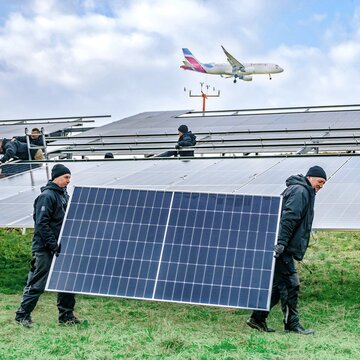
We generate electricity from solar panels across an area of more than 19,700 square metres – and this figure is rising. In addition, a combined heat and power (CHP) plant has been contributing to energy and heat generation since 2013. In 2025, the CHP plant generated 11.9 GWh of energy. With the carbon strategy STRzero , the plan is to replace the plant with heat pumps so that we are no longer dependent on fossil fuel sources .High-performance battery storage systems are also set to play a part in this . The airport commissioned its first such system, with a capacity of 540 kWh, in 2025. Further storage systems are planned as part of the expansion of the solar installations.

The airport sources the additional electricity required from the public grid and obtains guarantees of origin for this. These certify that this amount of electricity was generated from renewable energy sources and fed into the European electricity grid.

In addition to buildings and facilities, the airport’s numerous vehicles also require energy. These are charged at the airport’s own charging stations. In addition to electric passenger buses, these include baggage tractors, battery-powered vans, cargo tractors, conveyor belts, high-loaders and many other specialised vehicles. For vehicles without electric drives, Stuttgart Airport uses synthetic diesel (HVO). This produces significantly fewer pollutants than fossil fuels.

The airport operates an energy management system certified to the internationalISO 50001 standard.

In collaboration with the airlines, ground handling partners and DFS Deutsche Flugsicherung GmbH, Stuttgart Airport is optimising apron operations. The Airport Collaborative Decision Making (A-CDM) programme reduces the time aircraft spend taxiing to the runway – thereby keeping fuel consumption as low as possible. In the very first year, around 740 tonnes of carbon dioxide were saved.

Whilst an airport operator’s influence over aviation emissions is limited, we are nevertheless taking active steps in this area. Our schedule of charges is the first in Germany to offer financial incentives for the use of synthetic, electricity-based kerosene and for electric aviation.

Electric flight is also being specifically promoted – including through research funding. In 2016, the HY4 took off from Stuttgart Airport on the world’s first passenger flight powered by fuel cells. The four-seater aircraft was developed by the Stuttgart-based technology companyH2FLY. The propulsion system is currently being further developed for a 30-seater aircraft.

Airport Carbon Accreditation

Through structured environmental management and innovative technologies, Stuttgart Airport is working consistently to reduceCO₂eq emissions on the ground and – within the limits of its capabilities – in the air as well. For this, STR has been certified at Level 4 by Airport Carbon Accreditation (ACA).

The climate management initiative run by the European airport associationACI Europe assesses airports’ CO₂ management across a series of progressive levels: Level 1, Level 2, Level 3, Level 3+, Level 4, Level 4+ and Level 5.

To be certified at one of the programme’s seven levels, airports must have their carbon footprint and carbon management processes independently verifiedbya certified body. 

Conserving resources, protecting the environment

Stuttgart Airport is committed to treating the environment and resources responsibly, going beyond what is required by law. Waste management, protection of adjacent water bodies and measures to preserve biodiversity on the airport grounds contribute to a steady reduction in the ecological footprint.

Eine Person arbeitet im Abfallwirtschaftszentrum auf einer erhöhten Plattform auf einem Silo mit dem Schriftzug "Umwelttechnik". Im Hintergrund ist das Terminalgebäude.

Waste Disposal and Resource Management

Waste can be a valuable resource. Stuttgart Airport recognised this as early as 1997 and established its own waste management centre that year. The certified waste management company sorts waste into more than 60 different categories and then passes it on to external waste disposal firms.

Two examples: the rubber abrasion generated when aircraft tyres make contact with the runway is thermally recycled. Grass clippings from mowing operations are sent to a biogas plant in Leinfelden-Echterdingen.

In a heavily frequented place such as STR, waste cannot be completely avoided. What matters is how the resulting volumes are managed. Pictograms on the bins at the airport help passengers choose the correct bin and thus make their own contribution to waste management.

Development in Airport City

Stuttgart Airport is a sought-after location for businesses. Flughafen Stuttgart GmbH is continuously developing the office and retail space on the site – in line with demand and, for reasons of space, mostly upwards. The total floor area now comprises around 550,000 square metres, including car park space.

Flughafen Stuttgart GmbH is the first airport operator in Germany to have the entire Stuttgart Airport City business district pre-certified in accordance with the criteria of the German Sustainable Building Council (DGNB e.V.) . 

We have developed our own requirements for our operational buildings. These are based on recognised standards and take into account both the carbon footprint and the entire life cycle of a building. Furthermore, technical, economic, environmental and usage-related aspects are incorporated into the planning and development of construction projects.
De-icing and Water Protection

To ensure that aircraft can take off safely in frosty conditions, they are treated with a glycol-based de-icing agent. Modern equipment ensures that the dosage is tailored to requirements, adjusting the mixing ratio according to weather conditions. Special tanks beneath the de-icing stations collect any residual liquid. Rainwater contaminated with de-icing agents is biologically pre-treated before it is permitted to be discharged into public waterways. This process reduces the organic carbon content, ensuring that all limit values are complied with.

The ground handling subsidiary SAG uses a de-icing simulator. This enables the team to practise the correct use of de-icing vehicles virtually and under various weather conditions. 

Stuttgart Airport offers financial incentives for aircraft de-icing: the fee is based on the quantity of de-icing fluid used.

Unterirdisches Regenrückhaltebecken aus Beton mit regelmäßig angeordneten Stützpfeilern und etwas Wasser im Becken.

Drainage

The airport’s infrastructure is fundamentally prepared for heavy rainfall events, which are becoming more frequent and extreme as a result of climate change: High-capacity systems channel rainwater from the runway, taxiways and apron into underground treatment and retention basins with a total volume of over 100,000 cubic metres. These basins are crucial for flood protection – they prevent large volumes of water from flowing uncontrollably into surrounding streams, lakes or residential areas.

The discharge of uncontaminated surface water is also strictly regulated and permitted only with the approval of the relevant authorities. Since the 1990s, Flughafen Stuttgart GmbH has invested over 120 million euros in its facilities and, in doing so, in the protection of groundwater and public water bodies. The quality of these water bodies has improved as a result.

Youtube Video Poster

Biodiversity

Just under half of the approximately 400-hectare site is covered with smooth oat-grass and red fescue meadows. These areas provide a habitat for numerous plants and animals. The diversity of species is maintained through targeted grassland management .

In 2025, around 400 tonnes of grass clippings were produced during mowing. The University of Hohenheim regularly analyses the clippings – so far without any evidence of contamination. This also applies to the honey produced by the bee colonies located on the site near the runway. Since 2012, the State Institute for Apiculture has confirmed that flight operations have no negative impact on honey quality. The bees thus contribute to biomonitoring.

Air quality

Clean air is essential for good health and quality of life. Stuttgart Airport therefore adheres to the precautionary principle. Air quality is continuously monitored – all relevant data on air quality control and the minimisation of pollutants is regularly analysed.

The vehicle fleet is gradually being converted to electric power. Vehicles that still run on internal combustion engines use synthetic diesel (HVO). This produces significantly less soot, particulate matter and CO₂ than conventional fuel – which improves air quality on the apron and creates healthier working conditions.

Nevertheless, ultrafine particles (UFPs) are also produced at Stuttgart Airport as a result of natural and technical combustion processes, particularly in aircraft engines. The airport takes its responsibility towards its staff and the local community seriously. In order to incorporate new scientific findings at an early stage, Flughafen Stuttgart GmbH is in regular contact with the authorities and other airports regarding the latest findings on UFP.

Other interesting topics

STRzero – Reducing emissions with local solutions

With its STRzero carbon strategy, Stuttgart Airport is pursuing specific targets.

Energy and Climate Master Plan

What steps need to be taken at Stuttgart Airport to achieve the 2040 climate target? The Energy and Climate Master Plan provides the answer.

Electric power at the STR

STR is driving forward electric mobility within its own organisation – through innovative research projects and a growing electric vehicle fleet