STRzero Carbon Strategy
A consistent course for genuine climate protection
Taking responsibility
Flughafen Stuttgart GmbH is taking decisive action to protect the climate. The airport demonstrates responsibility in its day-to-day operations – climate protection is a key area of focus for the STR and is firmly anchored in the company's strategy.
With its STRzero climate strategy, Flughafen Stuttgart GmbH is pursuing a clear goal: to achieve net-zero greenhouse gas emissions by 2040 in its Scope 1 and 2. STRzero offers a binding and ambitious roadmap for achieving this.

Climate and resources
A strong team for safety
Operating an airport has an impact on the environment – that is undisputed. At the same time, there are numerous ways to limit these effects. We implement targeted measures to reduce pollution in areas such as noise, greenhouse gas emissions and energy consumption.
Wherever it has influence, Flughafen Stuttgart GmbH is actively working to make operations more environmentally friendly.

Solar power from the airport
Local energy generation and storage
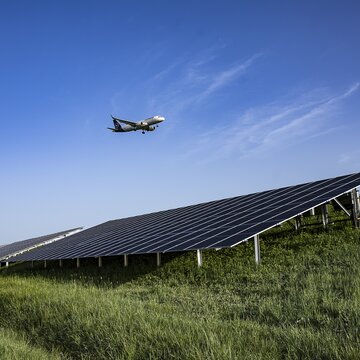
With the rising number of electric vehicles at the airport, the demand for electricity is also increasing. To meet this demand, the airport is expanding its solar installations.
We currently generate solar power at seven locations across the campus: on the roofs of the Bosch car park, the Stuttgart Airport bus terminal, the P11 car park, the SkyPort building, the combined storage facility and an apron gate. Our first ground-mounted photovoltaic system is situated to the west, within the airport perimeter fence.
The expansion of photovoltaic systems at STR is a key investment focus of the Energy and Climate Master Plan.

Electric mobility
Ground handling, but without exhaust fumes
On the apron, we are increasingly relying on electric mobility. What began in 2013 with the first electric passenger bus has led to a fully battery-powered fleet of apron buses. The same applies to the baggage tractors at STR – these, too, are all emission-free. Taken together, all our electric vehicles and equipment already save around 1 million litres of diesel a year. This is a significant contribution to reducing CO₂eq emissions in aircraft ground handling.
E-mobility also has an impact on the working environment of our apron staff: air quality is improving and operations are becomingquieter.
Further investment in electric vehicles is planned as part of the implementation of the Energy and Climate Master Plan.